Mold · Clwyd
Floor joist repairs in Mold
Whether it is one soft patch by the bathroom or a whole room dropping towards the wall, floor joist repairs in Mold are priced only after the timber has been seen. Rot, notches and failed supports each need a different fix, and the quote says which.
Guide price from£230per joist inc VAT
- Postcodes
- CH7
- Population
- about 10,000
- Area
- Clwyd
- Pricing region
- Wales
Is Clwyd prone to ground movement?
Postcode districts CH7 cover Mold, a Clwyd town of about 10,000 people. Neighbouring towns we cover: Buckley (2 miles), Connah's Quay (5 miles) and Flint (5 miles).
Clay soils are found in parts of Clwyd. Parts of Clwyd lie on a former coalfield, so a coal mining search is worth checking if movement has no obvious cause. Housing stock in Clwyd: Brick colliery terraces, seaside villas in Rhyl and Colwyn Bay, and post-war estates.
Symptoms that point to floor joist repairs
- Floor dipping towards an outside wall or in the middle of the room
- Soft or spongy boards near outside walls, hearths or the bathroom
- Ceiling cracks below that follow the line of the joists
Guide prices for floor joist repairs in Mold
For Mold we use Wales rates. Treat the table as a budget guide, inc VAT; the price you pay is the one on your written quote.
| Item | Guide price | Per |
|---|---|---|
| Splicing or sistering a damaged joist | £230 – £370 | per joist |
| Whole room of joists and boards | £1,850 – £5,500 | per room |
| Sleeper wall rebuild and ventilationest. | £370 – £1,400 | per room |
Methods for floor joist repairs
Sleeper walls and ventilation
Settled or damp sleeper walls are rebuilt on a sound base with a damp-proof course under new timber plates. Blocked air bricks are cleared, extra ones added where the void has dead spots, and soil or paving heaped against the outside wall is lowered.
Best for: Damp ground floor voids or joists on poor supports
Replacing joists and boards
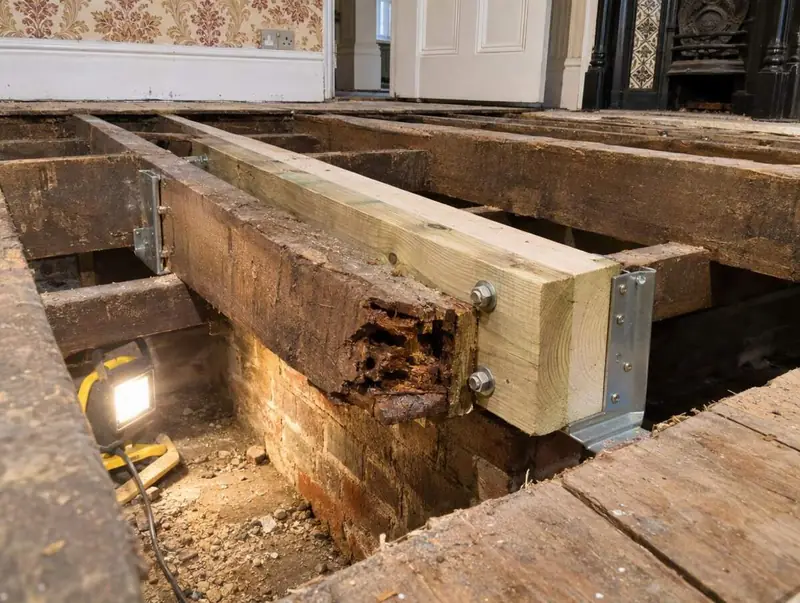
When rot or woodworm runs through most of a floor, it is usually cheaper to replace the joists, strutting and boards together. Where joists run parallel to an outside wall, restraint straps tie the new floor back to it so the wall keeps its lateral support.
Best for: Widespread rot, or a whole floor that has dropped
From first photo to finished repair
Lift boards and inspect
On site we lift a few boards where the floor is worst and check the joist ends, sleeper walls and void with a moisture meter. Outside, we look for high ground, blocked vents and leaks keeping the timber wet.
Written quote
You get a no-obligation written quote listing which joists are sistered, spliced or replaced and any sleeper wall or ventilation work. It becomes a fixed price in writing once the repair is specified.
Relay and ventilate
Boards are relaid or replaced, skirting refitted and air bricks cleared or added outside. We point out anything that would let damp back in, such as soil heaped against the wall, so the repair lasts.
Rules for floor joist repairs in Wales
In Wales, small like-for-like repairs do not usually need approval, but work that alters or strengthens the structure needs building control under the Welsh Building Regulations, and the Party Wall etc. Act 1996 can apply to shared walls.
Frequently asked questions
How much should I budget for floor joist repairs in Mold?
Guide prices for floor joist repairs in Mold start from about £230 per joist, including VAT, on Wales rates. Your fixed written price follows photos or a survey and depends on the extent of the work and access.
Can you survey a property in Mold?
We do. Mold and the surrounding area are covered, including nearby Buckley and Connah's Quay. A free initial assessment from your photos is the first step.
Why do houses in Clwyd crack?
The North Wales coalfield runs beneath parts of Wrexham and Flintshire, where historic workings are recorded, while the coast and vale have glacial clays and the hills are older hard rock. Only an investigation can say why a particular building has moved.
What is sistering a floor joist?
Sistering is fixing a new length of timber alongside an existing joist so the two share the load. It strengthens a notched, cracked or sagging joist without removing it, so it is quicker and less disruptive than replacement.
What causes rot in floor joists?
Damp causes almost all joist rot. Joist ends in damp walls, voids with blocked air bricks, leaking pipes and high outside ground levels keep timber wet enough for fungi to grow. Replacing timber without fixing the damp usually means the rot returns.
Related work in Mold
- Gable end wall repairs
- Structural crack repairs
- Lintel replacement
- Concrete repairs
- Resin injection ground stabilisation
Floor joist repairs near Mold
Send photos of the floor and the outside wall at your Mold property for a free initial assessment and a no-obligation written quote.