Cambridgeshire · England
Structural surveys and crack monitoring in Cambridgeshire
Homes in Cambridgeshire are mostly Victorian terraces in Cambridge and Peterborough. That matters for structural surveys and crack monitoring: footings, wall construction and mortar all vary with the age of the building. Much of Cambridgeshire sits on clay that shrinks in dry summers and swells in wet winters.
Guide price from£525per property inc VAT
- Area
- Cambridgeshire
- Pricing region
- East of England
- Ground
- Shrinkable clay widespread
- Towns listed
- 8
How do local ground conditions affect structural surveys and crack monitoring in Cambridgeshire?
Gault Clay underlies much of the Cambridge area and Oxford Clay the west of the county around Peterborough and Huntingdon, while the northern fens are peat and silt that can shrink as they dry. Both clay and peat ground can move with the seasons.
Ground movement here is more often linked to soils, drains and trees than to mining. Across Cambridgeshire, most homes are Victorian terraces in Cambridge and Peterborough, fen-edge cottages, and extensive post-war and new-build estates.
Signs you may need structural surveys and crack monitoring
- A mortgage valuation recommending a structural engineer’s report
- Cracks that seem wider after a hot, dry summer
- Cracks reopening after being filled and decorated
- An insurer or loss adjuster asking for monitoring
How much will structural surveys and crack monitoring cost in Cambridgeshire?
The ranges below reflect typical East of England costs for structural surveys and crack monitoring, including VAT. Scaffold, access and making good can push a job to the top of the range.
| Item | Guide price | Per |
|---|---|---|
| Structural engineer's inspection and report | £525 – £2,100 | per property |
| Crack monitoring: installation and three seasonal readings | £1,500 – £2,500 | per programme |
| Extra monitoring visit | £440 | per visit |
Which repair method suits a home in Cambridgeshire?
Engineer’s structural inspection and report
A chartered structural engineer visits, records the cracks, checks the walls, floors, drains and nearby trees, and writes a report on the likely cause and next steps. It may recommend monitoring, investigations such as trial pits, or a repair specification.
Best for: A first expert opinion on any significant cracking
Tell-tales and crack-width monitoring
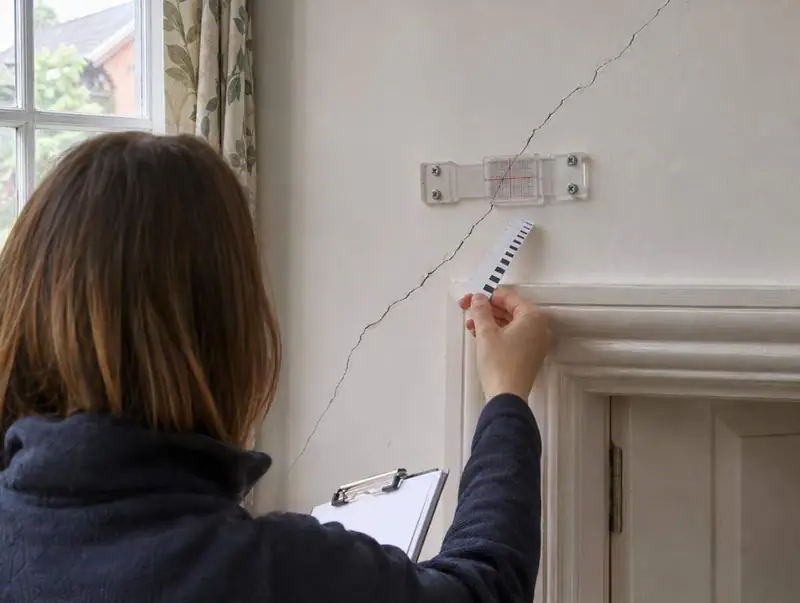
Gauges are fixed across key cracks and read at set intervals, or reference studs are measured with callipers to a fraction of a millimetre. The readings show whether each crack is widening, closing or stable, and whether any change follows the seasons.
Best for: Tracking individual cracks over the seasons
Level monitoring
Survey points are fixed around the building and their heights measured against a stable datum on each visit. This shows whether one part of the house is dropping or rising compared with the rest, which crack widths alone cannot reveal.
Best for: Suspected subsidence or heave across a whole house
What happens when we carry out structural surveys and crack monitoring in Cambridgeshire?
Free initial assessment
Send photos of the cracks with something for scale and tell us when they appeared. We give a free view on whether an engineer’s inspection is worthwhile, and whether your insurer should be told first.
Engineer’s inspection
We can arrange an independent chartered structural engineer to inspect. They record the damage, assess likely causes and recommend whether monitoring, drain surveys or trial pits are needed before any repair decision.
Seasonal readings
Readings are taken at intervals across the seasons, typically including late summer when clay is driest and late winter when it is wettest. The engineer checks each set against the base reading and decides whether more visits are needed.
Do you need approval for structural surveys and crack monitoring in England?
Like-for-like repairs such as crack stitching and repointing do not usually need building control approval in England, but anything that changes or strengthens the structure, such as underpinning or rebuilding a wall, does. If the work touches a party wall, the Party Wall etc. Act 1996 may apply.
Towns in Cambridgeshire we cover for structural surveys and crack monitoring
Structural surveys and crack monitoring in Cambridgeshire: questions and answers
Is the ground in Cambridgeshire prone to subsidence?
Gault Clay underlies much of the Cambridge area and Oxford Clay the west of the county around Peterborough and Huntingdon, while the northern fens are peat and silt that can shrink as they dry. Both clay and peat ground can move with the seasons. Ground movement here is more often linked to soils, drains and trees than to mining. Only an investigation on site can say why a particular building has moved.
How much will structural surveys and crack monitoring cost in Cambridgeshire?
On East of England rates, structural surveys and crack monitoring starts from about £525 per property, including VAT. The written price depends on the extent of the damage, access and whether an engineer or building control is needed.
What is a tell-tale on a crack?
A tell-tale is a small gauge fixed across a crack, with two overlapping plates marked in millimetres. As the crack opens, closes or shears, the plates move against each other and the reading changes. It gives a simple, repeatable record that anyone can check between visits.
Can I monitor cracks myself?
You can keep a useful record by photographing cracks with a ruler and pencilling dated marks at their ends. That helps an engineer, but it does not replace measured monitoring, which insurers and lenders usually expect. Do not fill or decorate over cracks while monitoring.
How long does crack monitoring take?
Monitoring normally runs for 6 to 12 months, because readings need to cover both the dry and wet seasons on clay soils. Shorter periods can be enough where the cause is clearly non-seasonal, such as a drain leak that has been repaired. The engineer decides when there is enough evidence.