Derbyshire · England
Bowing wall repairs in Derbyshire
We arrange surveys and price bowing wall repairs throughout Derbyshire. Clay soils are found in parts of Derbyshire, and we take that into account before recommending a method.
Guide price from£980per wall inc VAT
- Area
- Derbyshire
- Pricing region
- East Midlands
- Ground
- Clay in parts
- Towns listed
- 13
What is the ground like in Derbyshire?
East Derbyshire, including Chesterfield, Ilkeston and Heanor, lies on the Coal Measures with a long history of shallow and deep coal mining. The Peak District to the west is limestone and gritstone, and Derby itself sits largely on Mercia Mudstone.
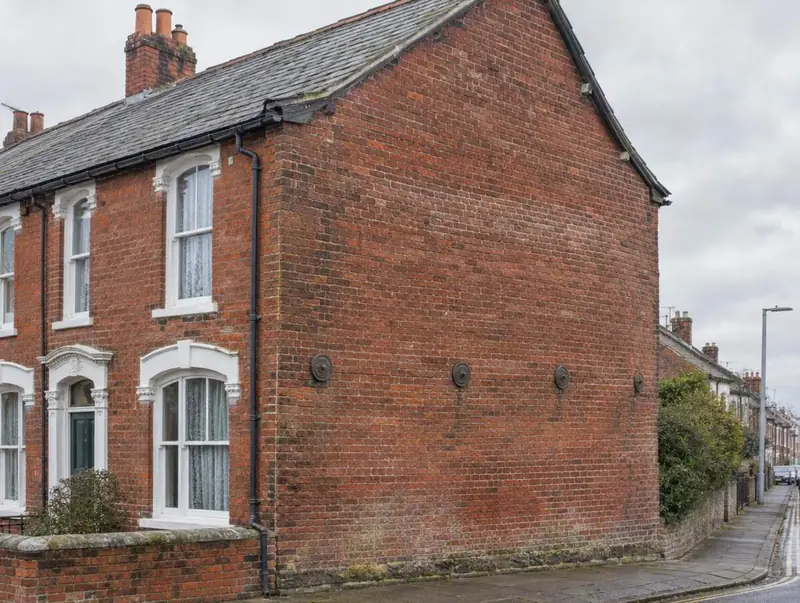
Parts of Derbyshire lie on a former coalfield, so a coal mining search is worth checking if movement has no obvious cause. Across Derbyshire, most homes are brick terraces in former mining towns, gritstone cottages in the Peak, and inter-war and post-war semis.
Methods for bowing wall repairs
Partial rebuild
A section that has bowed beyond safe limits, or where bricks have crushed, is propped, taken down and rebuilt plumb with restraint built in. It is the most disruptive option, so it is kept to the area that genuinely needs it.
Best for: Badly distorted sections that cannot be tied back
Stitching a delaminating wall
Where the layers of a solid wall have separated, long stainless ties are drilled in from the face and bonded into the inner layer to bind the wall together again. This is often combined with restraint ties, so the wall is both reconnected through its thickness and tied back to the structure.
Best for: Solid walls where the outer layer has pulled away
Restraint ties into the floor
Stainless restraint ties are drilled through the wall and fixed into the floor joists or into blocking between them. Where joists run parallel, noggins are fitted across several joists so the tie has something solid to hold. A neat plate or a buried fixing is left on the outside face.
Best for: Walls bowing at floor level where joists run alongside
From first photo to finished repair
Assess the bow
We look at where the wall bows, how far it is out of plumb and how the floors and roof meet it. Photographs from your phone held flat against the wall often show the shape clearly before anyone visits.
Open up inside
Floorboards or a ceiling strip are lifted along the affected wall to expose the joists. We fit noggins where joists run alongside, and plan furniture moves with you, since this is the most disruptive part of the job.
Fit the ties and straps
Ties are drilled through and fixed, or straps fitted and secured, at the spacing specified. Any rebuild is carried out at this stage, with temporary propping in place until the new brickwork has gained strength.
Symptoms that point to bowing wall repairs
- Gaps opening between floorboards and the skirting on an outside wall
- A visible belly in the wall when you sight along it
- Horizontal cracking at first-floor or ceiling level
- Gutters or the roof edge no longer lining up with the wall
Guide prices for bowing wall repairs in Derbyshire
Prices in Derbyshire are worked out on East Midlands rates. They include VAT and are a starting point: access, the extent of the damage and whether an engineer or building control is involved all move the figure.
| Item | Guide price | Per |
|---|---|---|
| Lateral restraint for a typical gable | £980 – £2,950 | per wall |
| Remedial restraint ties installed | £25 – £60 | per tie |
| Partial rebuild of a badly distorted sectionest. | £2,950 – £7,850 | per section |
Do you need approval for bowing wall repairs in England?
In England, underpinning and other work that alters or strengthens a wall or foundation is building work under the Building Regulations (Part A, structure), so building control approves and inspects it. Like-for-like repairs often are not, and we tell you which applies before a price is agreed. Work to a party wall, or excavation close to a neighbour’s foundations, can also need a notice under the Party Wall etc. Act 1996.
Find bowing wall repairs in your Derbyshire town
- Derby
- Chesterfield
- Long Eaton
- Ilkeston
- Swadlincote
- Belper
- Heanor
- Alfreton
- Dronfield
- Ripley
- Buxton
- New Mills
- Glossop
Frequently asked questions
Why do houses in Derbyshire crack?
East Derbyshire, including Chesterfield, Ilkeston and Heanor, lies on the Coal Measures with a long history of shallow and deep coal mining. The Peak District to the west is limestone and gritstone, and Derby itself sits largely on Mercia Mudstone. Parts of Derbyshire lie on a former coalfield, so a coal mining search is worth checking if movement has no obvious cause. Only an investigation on site can say why a particular building has moved.
How much will bowing wall repairs cost in Derbyshire?
On East Midlands rates, bowing wall repairs starts from about £980 per wall, including VAT. The written price depends on the extent of the damage, access and whether an engineer or building control is needed.
What is lateral restraint?
Lateral restraint is the connection that stops a wall moving sideways, provided by tying it to the floors and roof. Older houses often have little or none, especially where joists run parallel to the wall. Remedial ties and straps add that connection after the event.
Can a bowing wall be pushed back straight?
Usually not. Masonry rarely returns to plumb without cracking, so the normal aim is to stop further movement and leave the wall where it is. If the bow is too great to accept, that section is rebuilt rather than forced back.
Will I need to move out during bowing wall repairs?
Usually not. Restraint work means lifting some floorboards or a strip of ceiling along one wall, so a room or two is disrupted for a few days. A partial rebuild of an external wall can be more involved, and we will talk it through with you first.