Cornwall · England
Underpinning in Cornwall
Looking for underpinning in Cornwall? Send us photos for a free initial view. Most of Cornwall is on firmer ground than the clay belts of the south-east, so we look at the ground, drains and nearby trees before recommending anything.
Guide price from£1,050per metre of wall inc VAT
- Area
- Cornwall
- Pricing region
- South West
- Ground
- Mostly firmer ground
- Towns listed
- 9
What should you know about the ground under Cornwall?
Cornwall is mostly granite and slate with little shrinkable clay, so clay subsidence is less common than in the south-east. Historic tin and copper mining has left shafts and workings in places such as Camborne and Redruth, and mining searches are routine there.
Old metal-mine shafts and workings are recorded in places, so mining searches are routine for some properties. Housing stock in Cornwall: Granite and slate-stone cottages, cob buildings, Victorian terraces and post-war estates.
How we usually approach underpinning
Mini-piled underpinning
Small-diameter piles are driven or bored down to firm ground and linked by a reinforced beam or needles that pick up the wall. Compact rigs fit through narrow access, and the method reaches depths that would be impractical to excavate by hand.
Best for: Deep soft ground, tree roots, or restricted access
Beam-and-base underpinning
A reinforced concrete beam is cast beneath or alongside the existing footing and carries the wall onto mass concrete bases at intervals. It spreads load well across variable ground and can mean less digging than continuous underpinning along the whole wall.
Best for: Longer runs of wall or heavier loads over variable ground
Mass concrete underpinning
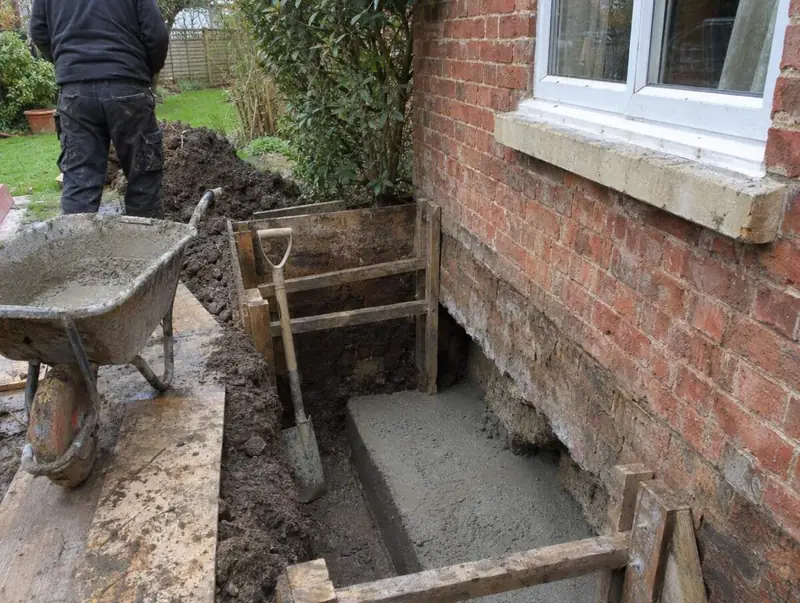
The traditional method. Short sections under the wall are dug out in a set sequence, usually about a metre at a time, and filled with concrete before the next section is opened. It suits moderate depths and good access, and it needs little specialist plant.
Best for: Shallow failures on firm ground found at moderate depth
What happens during underpinning, step by step?
Engineer’s investigation
An independent chartered structural engineer studies the monitoring results, trial pits and soil tests, then decides whether underpinning is needed and which method suits. We can arrange the engineer if you do not already have one.
Excavation and concrete
Work runs in the sequence the engineer sets so the wall is never left unsupported over a long length. Building control inspects the excavations before concrete goes in, and each section is dry-packed tight to the footing above.
Crack repairs and handover
Once the new foundation has cured, cracks are stitched and repointed, inside walls are made good, and paths or patios disturbed by the dig are reinstated. You receive the building control completion paperwork for your records.
What to look for before calling about underpinning
- Cracks that keep widening after the drains have been repaired
- Floors sloping noticeably towards one external wall
- One corner of the house visibly lower than the others
- A large tree nearby that cannot be removed or reduced
Underpinning prices in Cornwall
These are guide prices for Cornwall, using South West rates and including VAT. Your written quote follows photos or a survey, and is fixed once the repair is specified.
| Item | Guide price | Per |
|---|---|---|
| Mass-concrete underpinning | £1,050 – £1,550 | per metre of wall |
| Beam-and-base underpinning | £1,550 – £2,600 | per metre of wall |
| Mini-piled underpinning | £2,050 – £3,600 | per metre of wall |
| Engineer's design and building control feesest. | £825 – £2,600 | per scheme |
Do you need approval for underpinning in England?
In England, underpinning and other work that alters or strengthens a wall or foundation is building work under the Building Regulations (Part A, structure), so building control approves and inspects it. Like-for-like repairs often are not, and we tell you which applies before a price is agreed. Work to a party wall, or excavation close to a neighbour’s foundations, can also need a notice under the Party Wall etc. Act 1996.
Find underpinning in your Cornwall town
Questions about underpinning in Cornwall
Why do houses in Cornwall crack?
Cornwall is mostly granite and slate with little shrinkable clay, so clay subsidence is less common than in the south-east. Historic tin and copper mining has left shafts and workings in places such as Camborne and Redruth, and mining searches are routine there. Old metal-mine shafts and workings are recorded in places, so mining searches are routine for some properties. Only an investigation on site can say why a particular building has moved.
How much will underpinning cost in Cornwall?
On South West rates, underpinning starts from about £1,050 per metre of wall, including VAT. The written price depends on the extent of the damage, access and whether an engineer or building control is needed.
Does my house really need underpinning?
Often not, because most subsidence is fixed by repairing drains or managing trees and then repairing the cracks. Underpinning is justified when monitoring shows movement continuing after the cause has been dealt with, or when the ground itself is unsuitable. An independent engineer should make that call.
Can I stay in my house during underpinning?
Most people stay at home during external underpinning, because the digging happens outside along the wall. Expect noise, restricted access to that side of the house and some dust. If the work has to be done from inside, through the floor, moving out for part of the job is sometimes advised.
Which underpinning method is best?
The right method depends on how deep firm ground lies, the load on the wall and the access. Mass concrete suits moderate depths, beam-and-base spreads heavier loads, and mini-piles reach deep soft ground or work through tight access. The engineer chooses the method from the site investigation.