Stirling, Falkirk and Clackmannanshire · Scotland
Subsidence repairs in Stirling, Falkirk and Clackmannanshire
If you live in Stirling, Falkirk and Clackmannanshire and are looking at subsidence repairs, the first question is why the wall moved. Shrinkable clay is less common in Stirling, Falkirk and Clackmannanshire than in south-east England; historic coal workings are recorded beneath parts of Stirling, Falkirk and Clackmannanshire, and a coal mining search is worth checking where movement is unexplained.
Guide price from£2,400per property inc VAT
- Area
- Stirling, Falkirk and Clackmannanshire
- Pricing region
- Scotland
- Ground
- Mostly firmer ground
- Towns listed
- 5
Why does the ground in Stirling, Falkirk and Clackmannanshire matter for subsidence repairs?
The Forth valley has soft carse clays near the river, which can settle, and coalfields beneath Falkirk, Clackmannanshire and the south of Stirling with recorded historic workings.
Historic coal workings are recorded beneath parts of Stirling, Falkirk and Clackmannanshire, and a coal mining search is worth checking where movement is unexplained. Typical buildings in Stirling, Falkirk and Clackmannanshire: Stone tenements and villas, miners' rows and post-war estates.
How we usually approach subsidence repairs
Remove the cause, then repair
Most subsidence is dealt with this way. The drain is repaired or the vegetation managed, the house is watched to confirm it has stabilised, and then the cracks are stitched, repointed and made good inside. It is the least disruptive route and usually the cheapest.
Best for: Clay movement or drain leaks where the cause can be removed
Foundation strengthening
Where the ground cannot be made stable, the load is carried down to firmer soil by underpinning, a beam-and-base scheme, mini-piles or resin injection, depending on the soil and access. It is designed by an engineer and is the exception, not the rule.
Best for: Ongoing movement where removing the cause has not worked
Crack stitching and making good
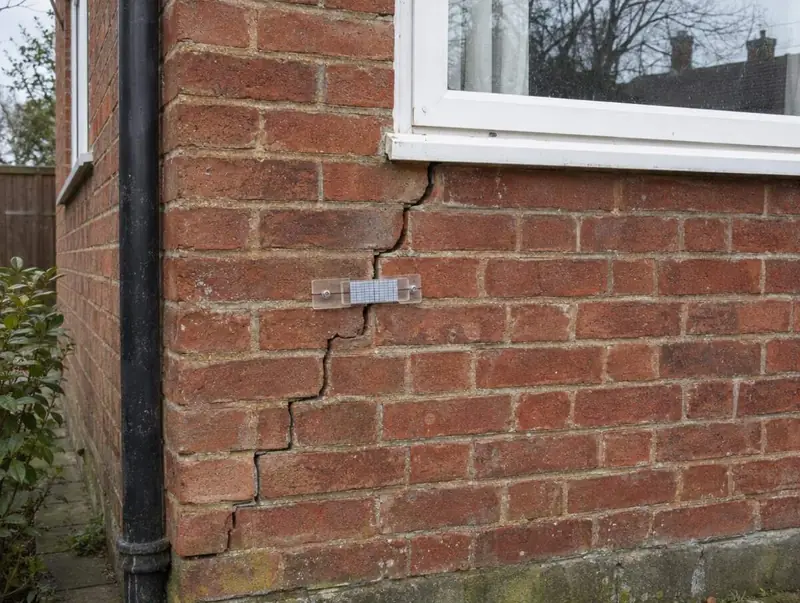
Once movement has stopped, cracked brickwork is cut along the bed joints, stainless helical bars are bonded in to tie the wall together, and the joints are repointed to match. Inside, plaster is renewed along the crack line before redecoration.
Best for: Category 1 to 3 cracking in walls that are otherwise sound
What happens during subsidence repairs, step by step?
Send photos or call
Send photos of the cracks with a coin or tape for scale, and say when you first noticed them. We give a free initial assessment and suggest whether an engineer, a drain survey or your insurer comes first.
Find the cause
An independent chartered structural engineer inspects the house and, where needed, arranges a drain survey, trial pits or soil tests. We can arrange the engineer. The aim is to know what is moving, and why, before money goes on repairs.
Written quote
We price the agreed repair and confirm a fixed price in writing once it is specified. If there is an insurance claim, we can price to the loss adjuster’s or engineer’s schedule instead of our own scope.
What to look for before calling about subsidence repairs
- Diagonal cracks wider at the top, running from window or door corners
- Fresh cracks showing on both the inside and outside of one wall
- Wallpaper rippling or tearing where the wall meets the ceiling
- Doors and windows that start to stick or no longer close
Subsidence repairs prices in Stirling, Falkirk and Clackmannanshire
For Stirling, Falkirk and Clackmannanshire we use Scotland rates. Treat the table as a budget guide, inc VAT; the price you pay is the one on your written quote.
| Item | Guide price | Per |
|---|---|---|
| Structural engineer's investigation and report | £475 – £1,900 | per property |
| CCTV drain survey (common first check) | £140 – £330 | per survey |
| Typical repair once the cause is dealt with: crack stitching and making goodest. | £2,400 – £11,400 | per property |
| Foundation strengthening where it is needed (see underpinning) | £950 – £3,300 | per metre of wall |
Do you need approval for subsidence repairs in Scotland?
In Scotland, underpinning and other structural alterations generally need a building warrant from the council’s building standards service before work starts, and a completion certificate at the end; small like-for-like repairs often do not. There is no Party Wall Act in Scotland; shared walls are covered by title deeds and, for flats, the Tenements (Scotland) Act 2004.
Towns in Stirling, Falkirk and Clackmannanshire we cover for subsidence repairs
Questions about subsidence repairs in Stirling, Falkirk and Clackmannanshire
Is the ground in Stirling, Falkirk and Clackmannanshire prone to subsidence?
The Forth valley has soft carse clays near the river, which can settle, and coalfields beneath Falkirk, Clackmannanshire and the south of Stirling with recorded historic workings. Historic coal workings are recorded beneath parts of Stirling, Falkirk and Clackmannanshire, and a coal mining search is worth checking where movement is unexplained. Only an investigation on site can say why a particular building has moved.
How much will subsidence repairs cost in Stirling, Falkirk and Clackmannanshire?
On Scotland rates, subsidence repairs starts from about £2,400 per property, including VAT. The written price depends on the extent of the damage, access and whether an engineer or building control is needed.
Does subsidence always need underpinning?
No, most subsidence is repaired without underpinning. When a leaking drain is fixed or nearby vegetation is managed, the ground usually stabilises and the house needs only crack repairs. Foundation work is kept for movement that continues after the cause has gone.
How long should I wait before repairing subsidence cracks?
Usually until the cause has been dealt with and the engineer is satisfied that movement has stopped. On clay that can mean watching the house through a summer and a winter. Repairing too early risks the same cracks opening again.
Will past subsidence affect my home insurance?
It can, because insurers ask about previous subsidence at renewal or when you switch. Staying with the insurer who handled a claim is often simplest. Answer any new insurer’s questions honestly and keep the repair records, which show the problem was dealt with.