Cowdenbeath · Fife
Resin injection ground stabilisation in Cowdenbeath
A sunken floor slab or a settled corner in a Cowdenbeath home can sometimes be treated from the surface with expanding resin. Levels are read throughout, and monitoring afterwards shows whether the ground is holding before the cracks are repaired.
Guide price from£760per metre of wall treated inc VAT
- Postcodes
- KY4, KY5
- Population
- about 12,000
- Area
- Fife
- Pricing region
- Scotland
How do local ground conditions affect resin injection ground stabilisation in Cowdenbeath?
With roughly 12,000 people, Cowdenbeath spans postcode districts KY4, KY5 in Fife. If you are just outside Cowdenbeath, we also cover Dunfermline (5 miles), Rosyth (6 miles) and Kirkcaldy (7 miles).
Clay shrinkage is less of a concern in Fife, so other causes such as drains, poor footings or older walls are checked first. Historic coal workings are recorded beneath parts of Fife, and a coal mining search is worth checking where movement is unexplained. Typical buildings in Fife: Miners' rows, sandstone town houses, tenements and post-war estates.
Guide prices for resin injection ground stabilisation in Cowdenbeath
For Cowdenbeath we use Scotland rates. Treat the table as a budget guide, inc VAT; the price you pay is the one on your written quote.
| Item | Guide price | Per |
|---|---|---|
| Resin injection ground stabilisation | £760 – £1,400 | per metre of wall treated |
| Typical domestic project | £4,750 – £14,200 | per project |
| Level monitoring after treatmentest. | £330 – £855 | per programme |
Methods for resin injection ground stabilisation
Resin alongside other repairs
Injection often forms one part of a wider scheme: drains repaired first, resin under the affected section, then crack stitching and making good once readings settle. On a mixed site, one wall may suit resin while another needs conventional underpinning instead.
Best for: Localised settlement within a broader subsidence repair
Injection beneath strip footings
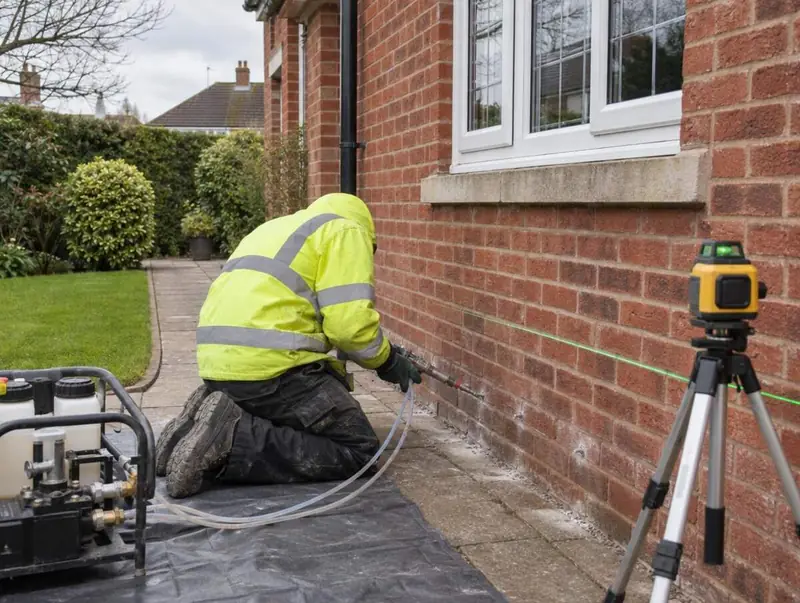
Holes are drilled at close spacing along the wall, and tubes are placed at one or more depths below the footing. Resin is injected in stages from the bottom up, building a stiffened zone of ground under the wall while levels are read continuously.
Best for: Settled walls on loose or washed-out soil at shallow depth
From first photo to finished repair
Ground and drain checks
Trial pits or probes confirm the soil profile, and a CCTV drain survey checks for leaks and for pipes in the injection zone. Damaged drains are repaired first, so resin is not lost into them or used to treat a cause that is still active.
Injection day
Holes are drilled, tubes placed and resin injected in stages while laser levels on the wall are watched for any rise. Most domestic jobs are done from outside, with little mess. Holes are filled and joints made good at the end.
Level monitoring
Readings after treatment show whether the ground is holding. Once they are steady, cracks are stitched and redecoration can follow. If a section keeps moving, the engineer decides whether further injection or a different method is needed.
Symptoms that point to resin injection ground stabilisation
- A corner that has dropped but no longer moves with the seasons
- Gaps opening beneath a ground-floor slab or path
- Cracks over a section of wall built on loose fill
Rules for resin injection ground stabilisation in Scotland
In Scotland, underpinning and other structural alterations generally need a building warrant from the council’s building standards service before work starts, and a completion certificate at the end; small like-for-like repairs often do not. There is no Party Wall Act in Scotland; shared walls are covered by title deeds and, for flats, the Tenements (Scotland) Act 2004.
Frequently asked questions
How much should I budget for resin injection ground stabilisation in Cowdenbeath?
Guide prices for resin injection ground stabilisation in Cowdenbeath start from about £760 per metre of wall treated, including VAT, on Scotland rates. Your fixed written price follows photos or a survey and depends on the extent of the work and access.
Can you survey a property in Cowdenbeath?
Yes. We take enquiries from across Cowdenbeath, including KY4, KY5, and from nearby places such as Dunfermline and Rosyth. Send photos for a free initial view and we will tell you what happens next.
Why do houses in Fife crack?
Much of central and west Fife lies on coalfields worked for centuries, with recorded shallow workings around Dunfermline, Cowdenbeath and Kirkcaldy, under a cover of glacial deposits. Only an investigation can say why a particular building has moved.
How do I know if my house is suitable?
An engineer decides, based on the soil type, the depth to firm ground and the cause of movement. Send us photos and any reports for a free initial assessment. We will say honestly if resin looks unlikely to suit and a different repair is worth considering.
Can resin injection lift my house back to level?
It can produce small, controlled lifts, but it is not a way to jack a house back to its original position. The main aim is to stabilise the ground. Laser levels are watched throughout so injection stops before the lift strains the walls or opens new cracks.
Related work in Cowdenbeath
- Brick arch repairs
- Extension pulling away repairs
- Crack stitching
- Boundary and garden wall repairs
- Structural surveys and crack monitoring
Resin injection ground stabilisation near Cowdenbeath
Wondering whether resin injection suits your Cowdenbeath home? Send photos and any reports for a free initial assessment and an honest view.