Dumfries and Galloway · Scotland
Resin injection ground stabilisation in Dumfries and Galloway
We arrange surveys and price resin injection ground stabilisation throughout Dumfries and Galloway. Clay shrinkage is less of a concern in Dumfries and Galloway, so other causes such as drains, poor footings or older walls are checked first, and we take that into account before recommending a method.
Guide price from£760per metre of wall treated inc VAT
- Area
- Dumfries and Galloway
- Pricing region
- Scotland
- Ground
- Mostly firmer ground
- Towns listed
- 3
How do local ground conditions affect resin injection ground stabilisation in Dumfries and Galloway?
Dumfries and Galloway is mainly older hard rock and red sandstone with glacial deposits, and soft estuarine ground along the Solway coast.
Ground movement here is more often linked to soils, drains and trees than to mining. What you mostly find across Dumfries and Galloway: red sandstone town houses, whitewashed cottages and post-war estates.
Methods for resin injection ground stabilisation
Slab void filling and lifting
Small holes are drilled through the floor, and resin is fed into the void between the slab and the fill. As it expands it fills the gap and can lift the slab by small, controlled amounts. Floor coverings are lifted locally and the holes filled afterwards.
Best for: Sunken concrete ground floors and garage slabs
Resin alongside other repairs
Injection often forms one part of a wider scheme: drains repaired first, resin under the affected section, then crack stitching and making good once readings settle. On a mixed site, one wall may suit resin while another needs conventional underpinning instead.
Best for: Localised settlement within a broader subsidence repair
Injection beneath strip footings
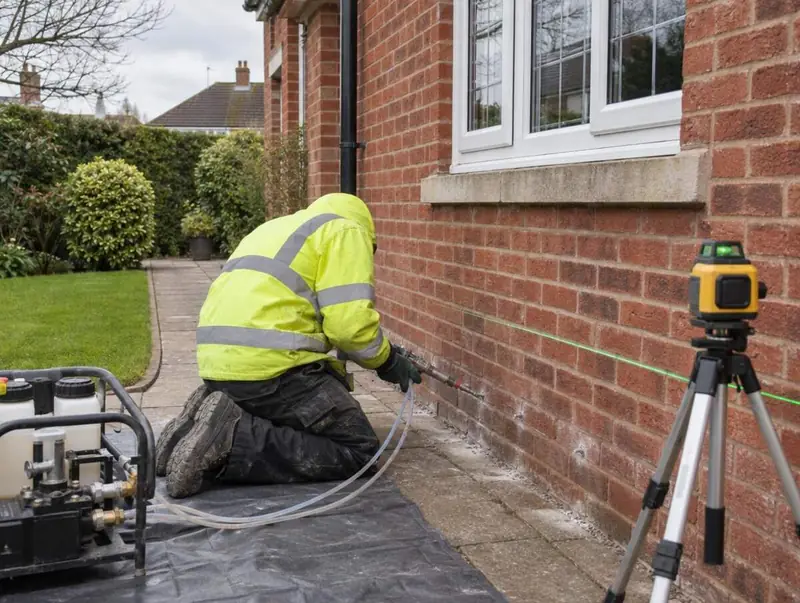
Holes are drilled at close spacing along the wall, and tubes are placed at one or more depths below the footing. Resin is injected in stages from the bottom up, building a stiffened zone of ground under the wall while levels are read continuously.
Best for: Settled walls on loose or washed-out soil at shallow depth
From first photo to finished repair
Ground and drain checks
Trial pits or probes confirm the soil profile, and a CCTV drain survey checks for leaks and for pipes in the injection zone. Damaged drains are repaired first, so resin is not lost into them or used to treat a cause that is still active.
Design and written price
The injection depths, spacing and target lift are set out before work starts. We confirm a fixed price in writing for the treated length, the monitoring and the making good, and deal with building control where the work needs it.
Level monitoring
Readings after treatment show whether the ground is holding. Once they are steady, cracks are stitched and redecoration can follow. If a section keeps moving, the engineer decides whether further injection or a different method is needed.
Symptoms that point to resin injection ground stabilisation
- Settlement after a drain leak has been found and repaired
- Gaps opening beneath a ground-floor slab or path
- Cracks over a section of wall built on loose fill
- Sinking that trial pits trace to loose or washed-out soil
Guide prices for resin injection ground stabilisation in Dumfries and Galloway
The ranges below reflect typical Scotland costs for resin injection ground stabilisation, including VAT. Scaffold, access and making good can push a job to the top of the range.
| Item | Guide price | Per |
|---|---|---|
| Resin injection ground stabilisation | £760 – £1,400 | per metre of wall treated |
| Typical domestic project | £4,750 – £14,200 | per project |
| Level monitoring after treatmentest. | £330 – £855 | per programme |
Do you need approval for resin injection ground stabilisation in Scotland?
In Scotland, underpinning and other structural alterations generally need a building warrant from the council’s building standards service before work starts, and a completion certificate at the end; small like-for-like repairs often do not. There is no Party Wall Act in Scotland; shared walls are covered by title deeds and, for flats, the Tenements (Scotland) Act 2004.
Towns in Dumfries and Galloway we cover for resin injection ground stabilisation
Frequently asked questions
Is the ground in Dumfries and Galloway prone to subsidence?
Dumfries and Galloway is mainly older hard rock and red sandstone with glacial deposits, and soft estuarine ground along the Solway coast. Ground movement here is more often linked to soils, drains and trees than to mining. Only an investigation on site can say why a particular building has moved.
How much will resin injection ground stabilisation cost in Dumfries and Galloway?
On Scotland rates, resin injection ground stabilisation starts from about £760 per metre of wall treated, including VAT. The written price depends on the extent of the damage, access and whether an engineer or building control is needed.
How do I know if my house is suitable?
An engineer decides, based on the soil type, the depth to firm ground and the cause of movement. Send us photos and any reports for a free initial assessment. We will say honestly if resin looks unlikely to suit and a different repair is worth considering.
Does resin injection work on clay soil?
Sometimes, but clay needs the most caution. If seasonal shrinkage from nearby trees is the cause, resin under the footing may not stop the drying below it. An engineer should look at the soil, the trees and the monitoring history before resin is chosen for a clay site.
Is resin injection better than underpinning?
It is better for some jobs and unsuitable for others. Resin is quicker and less disruptive where the problem is loose or washed-out soil close to the footing. Underpinning or mini-piles are usually the safer choice for deep soft ground or clay dried by trees that cannot be removed.