Cumbria · England
Resin injection ground stabilisation in Cumbria
Looking for resin injection ground stabilisation in Cumbria? Send us photos for a free initial view. Shrinkable clay is less common in Cumbria than in south-east England, so we look at the ground, drains and nearby trees before recommending anything.
Guide price from£770per metre of wall treated inc VAT
- Area
- Cumbria
- Pricing region
- North West
- Ground
- Mostly firmer ground
- Towns listed
- 6
What should you know about the ground under Cumbria?
Cumbria's ground is largely hard rock and glacial deposits, with the West Cumberland coalfield around Whitehaven and Workington where historic coal workings are recorded. Stone walls and older lime mortars feature in much of the housing.
Parts of Cumbria lie on a former coalfield, so a coal mining search is worth checking if movement has no obvious cause. Across Cumbria, most homes are stone-built terraces and farmhouses, sandstone town houses in Carlisle and post-war estates.
How we usually approach resin injection ground stabilisation
Resin alongside other repairs
Injection often forms one part of a wider scheme: drains repaired first, resin under the affected section, then crack stitching and making good once readings settle. On a mixed site, one wall may suit resin while another needs conventional underpinning instead.
Best for: Localised settlement within a broader subsidence repair
Slab void filling and lifting
Small holes are drilled through the floor, and resin is fed into the void between the slab and the fill. As it expands it fills the gap and can lift the slab by small, controlled amounts. Floor coverings are lifted locally and the holes filled afterwards.
Best for: Sunken concrete ground floors and garage slabs
Injection beneath strip footings
Holes are drilled at close spacing along the wall, and tubes are placed at one or more depths below the footing. Resin is injected in stages from the bottom up, building a stiffened zone of ground under the wall while levels are read continuously.
Best for: Settled walls on loose or washed-out soil at shallow depth
What happens during resin injection ground stabilisation, step by step?
Ground and drain checks
Trial pits or probes confirm the soil profile, and a CCTV drain survey checks for leaks and for pipes in the injection zone. Damaged drains are repaired first, so resin is not lost into them or used to treat a cause that is still active.
Injection day
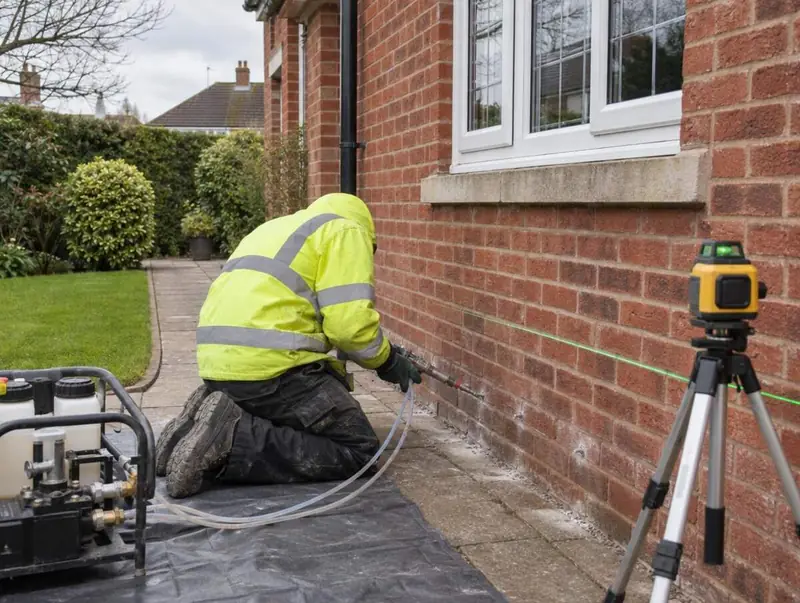
Holes are drilled, tubes placed and resin injected in stages while laser levels on the wall are watched for any rise. Most domestic jobs are done from outside, with little mess. Holes are filled and joints made good at the end.
Level monitoring
Readings after treatment show whether the ground is holding. Once they are steady, cracks are stitched and redecoration can follow. If a section keeps moving, the engineer decides whether further injection or a different method is needed.
What to look for before calling about resin injection ground stabilisation
- A corner that has dropped but no longer moves with the seasons
- Floor slab dropping or hollow-sounding near one external wall
- Gaps opening beneath a ground-floor slab or path
- Sinking that trial pits trace to loose or washed-out soil
Resin injection ground stabilisation prices in Cumbria
These are guide prices for Cumbria, using North West rates and including VAT. Your written quote follows photos or a survey, and is fixed once the repair is specified.
| Item | Guide price | Per |
|---|---|---|
| Resin injection ground stabilisation | £770 – £1,450 | per metre of wall treated |
| Typical domestic project | £4,800 – £14,400 | per project |
| Level monitoring after treatmentest. | £335 – £865 | per programme |
Do you need approval for resin injection ground stabilisation in England?
In England, underpinning and other work that alters or strengthens a wall or foundation is building work under the Building Regulations (Part A, structure), so building control approves and inspects it. Like-for-like repairs often are not, and we tell you which applies before a price is agreed. Work to a party wall, or excavation close to a neighbour’s foundations, can also need a notice under the Party Wall etc. Act 1996.
Towns in Cumbria we cover for resin injection ground stabilisation
Questions about resin injection ground stabilisation in Cumbria
Is the ground in Cumbria prone to subsidence?
Cumbria's ground is largely hard rock and glacial deposits, with the West Cumberland coalfield around Whitehaven and Workington where historic coal workings are recorded. Stone walls and older lime mortars feature in much of the housing. Parts of Cumbria lie on a former coalfield, so a coal mining search is worth checking if movement has no obvious cause. Only an investigation on site can say why a particular building has moved.
How much will resin injection ground stabilisation cost in Cumbria?
On North West rates, resin injection ground stabilisation starts from about £770 per metre of wall treated, including VAT. The written price depends on the extent of the damage, access and whether an engineer or building control is needed.
How do I know if my house is suitable?
An engineer decides, based on the soil type, the depth to firm ground and the cause of movement. Send us photos and any reports for a free initial assessment. We will say honestly if resin looks unlikely to suit and a different repair is worth considering.
Is the resin harmful to the ground or drains?
Once cured, the resin is inert in the ground. The practical risk is resin travelling into a damaged drain or service duct, which is why a CCTV drain survey comes first and any defects are repaired before injection. Services near the treated zone are located and protected.
Does resin injection work on clay soil?
Sometimes, but clay needs the most caution. If seasonal shrinkage from nearby trees is the cause, resin under the footing may not stop the drying below it. An engineer should look at the soil, the trees and the monitoring history before resin is chosen for a clay site.