Kensington and Chelsea · Greater London
Lintel replacement in Kensington and Chelsea
If a window at your Kensington and Chelsea property has started to stick and the brickwork above has dipped, the lintel is a likely suspect. Send pictures of both sides of the opening, and we will tell you what we think is happening.
Guide price from£940per opening inc VAT
- Postcodes
- SW3, SW5, SW7, SW10, W2
- Population
- about 140,000
- Area
- Greater London
- Pricing region
- London
How do local ground conditions affect lintel replacement in Kensington and Chelsea?
We cover the whole of Kensington and Chelsea, including postcode districts SW3, SW5, SW7, SW10, W2; about 140,000 people live in the borough. We also take enquiries from nearby Hammersmith and Fulham (1 miles), Westminster (2 miles) and Wandsworth (3 miles).
Much of Greater London sits on clay that shrinks in dry summers and swells in wet winters. Ground movement here is more often linked to soils, drains and trees than to mining. Across Greater London, most homes are Victorian and Edwardian terraces with shallow footings, inter-war semis in the outer boroughs, and converted flats and mansion blocks.
Repair options we may recommend
Replacement with a cavity tray
A damp-proof membrane is laid over the new lintel with stop ends and weep holes, so water running down the cavity is directed out rather than into the house. Many older lintels were installed without one, which is often why they failed.
Best for: Cavity walls with damp above windows
Inner and outer lintel replacement
Solid walls and some cavity walls carry separate lintels on the inside and outside faces. Where both have failed, each is replaced in turn, keeping the wall supported throughout. Internal plaster and reveals are then made good and redecorated where included.
Best for: Older solid walls with rotten timber across the inner face
What to expect when we carry out lintel replacement
Specify the replacement
We confirm the lintel type, length and bearing needed. For wide openings, bays or walls with unusual loads, an engineer may specify it, and where the repair needs an engineer’s design or sign-off we can arrange one.
Support the wall
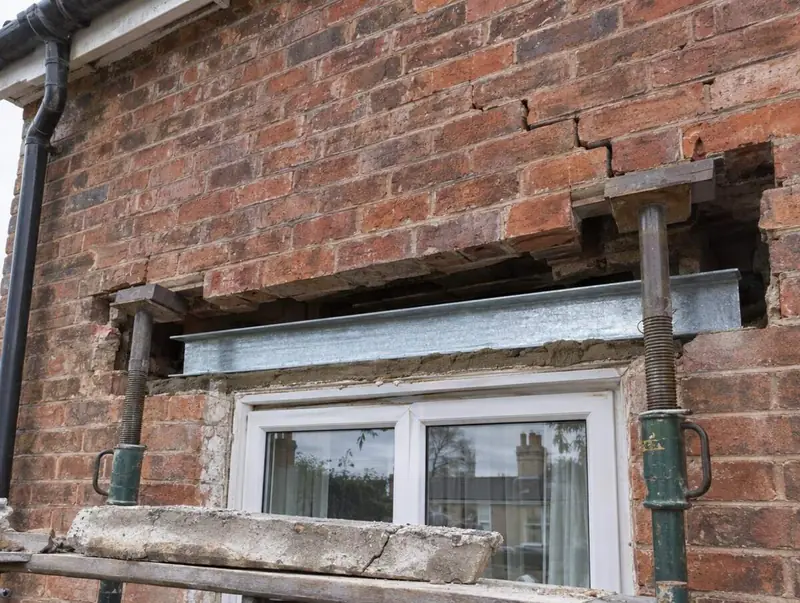
Props or needles are set so the brickwork above carries no load on the old lintel. Windows are protected or temporarily removed where the work demands it, and the room inside is sheeted against dust.
Remove and replace
Brickwork is carefully taken out above the lintel, the old lintel removed and the new one bedded level on full bearings. A cavity tray goes in where relevant, then the brickwork above is relaid.
Is it time for lintel replacement? Common signs
- Damp patches on the inside wall just above a window
- A diagonal crack climbing away from a window head
- Soft, crumbly timber visible behind the brick face over a bay
What should you budget for lintel replacement in Kensington and Chelsea?
For Kensington and Chelsea we use London rates. Treat the table as a budget guide, inc VAT; the price you pay is the one on your written quote.
| Item | Guide price | Per |
|---|---|---|
| Standard window or door opening | £940 – £3,100 | per opening |
| Wide or bay openingest. | £2,500 – £5,600 | per opening |
| Making good inside and outest. | £190 – £750 | per opening |
Rules for lintel replacement in England
In England, underpinning and other work that alters or strengthens a wall or foundation is building work under the Building Regulations (Part A, structure), so building control approves and inspects it. Like-for-like repairs often are not, and we tell you which applies before a price is agreed. Work to a party wall, or excavation close to a neighbour’s foundations, can also need a notice under the Party Wall etc. Act 1996.
Your lintel replacement questions
How much should I budget for lintel replacement in Kensington and Chelsea?
Guide prices for lintel replacement in Kensington and Chelsea start from about £940 per opening, including VAT, on London rates. Your fixed written price follows photos or a survey and depends on the extent of the work and access.
Can you survey a property in Kensington and Chelsea?
Yes. We take enquiries from across Kensington and Chelsea, including SW3, SW5, SW7, SW10, and from nearby places such as Hammersmith and Fulham and Westminster. Send photos for a free initial view and we will tell you what happens next.
Why do houses in Greater London crack?
Most of Greater London sits on London Clay, among the most shrinkage-prone ground in the UK, with river gravels along the Thames. Subsidence claims here are among the most frequent in the country, especially after dry summers and near street and garden trees. Only an investigation can say why a particular building has moved.
How do I know if a lintel has failed?
The most common sign is a diagonal or stepped crack running up from the top corner of a window or door. Others include a dip in the brickwork above, rust or rot visible at the lintel edge, and windows that start to stick. A crack alone can have other causes, so it is worth checking.
Can a lintel be replaced without removing the window?
Often yes. With the wall propped or needled, the old lintel can usually be cut out above the frame. If the frame has been carrying load or the lintel sits tight on it, the window may need removing and refitting, which we include in the quote.
Related work in Kensington and Chelsea
- Bay window subsidence repairs
- Resin injection ground stabilisation
- Retaining wall repairs
- Brick arch repairs
- Wall tie replacement
Lintel replacement near Kensington and Chelsea
If rust is showing above the windows of your Kensington and Chelsea home, photograph it close up and we will tell you whether replacement is due.