Stanford-le-Hope · Essex
Lintel replacement in Stanford-le-Hope
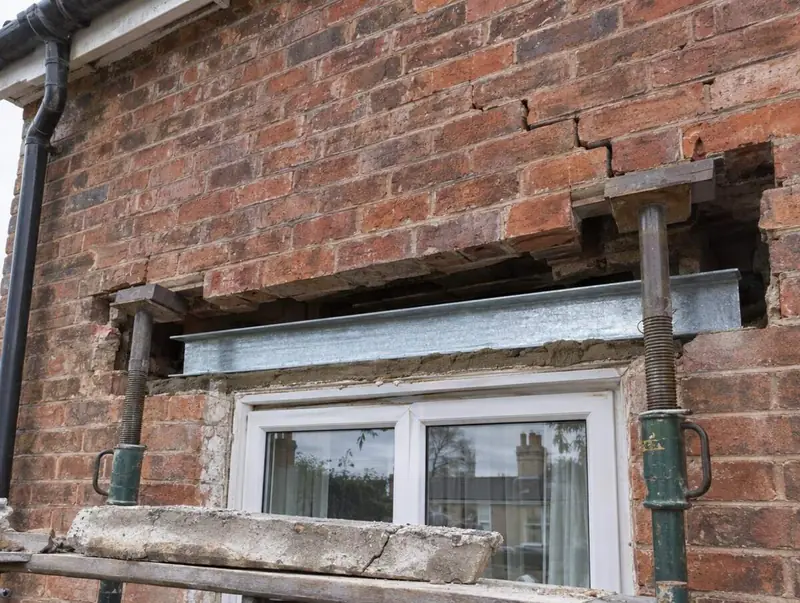
Lintels over existing windows and doors in Stanford-le-Hope homes are replaced one opening at a time, with the wall fully supported. Inside, rooms stay usable, with dust sheeting and making good included where you need it.
Guide price from£790per opening inc VAT
- Postcodes
- SS16, SS17
- Population
- about 30,000
- Area
- Essex
- Pricing region
- East of England
How do local ground conditions affect lintel replacement in Stanford-le-Hope?
With roughly 30,000 people, Stanford-le-Hope spans postcode districts SS16, SS17 in Essex. If you are just outside Stanford-le-Hope, we also cover Basildon (3 miles), Grays (6 miles) and Benfleet (6 miles).
Essex is one of the parts of the UK where clay soils are most likely to move with the seasons. Ground movement here is more often linked to soils, drains and trees than to mining. What you mostly find across Essex: Victorian terraces, 1930s semis and bungalows, and large post-war new-town estates in Basildon and Harlow.
What to look for before calling about lintel replacement
- Brickwork above an opening visibly dipping in the middle
- Soft, crumbly timber visible behind the brick face over a bay
- Rust stains or flaking steel showing above the frame
Lintel replacement prices in Stanford-le-Hope
Guide prices below are for homes in Stanford-le-Hope, on East of England rates and including VAT. A survey or good photos let us turn them into a fixed written price.
| Item | Guide price | Per |
|---|---|---|
| Standard window or door opening | £790 – £2,600 | per opening |
| Wide or bay openingest. | £2,100 – £4,700 | per opening |
| Making good inside and outest. | £160 – £630 | per opening |
How we usually approach lintel replacement
Like-for-like replacement
The failed lintel comes out and one of suitable type and size is bedded on mortar with adequate bearing at each end. Bricks above are relaid to match the original bond and the joints are pointed to blend with the surrounding wall.
Best for: Standard windows and doors with a single failed lintel
Inner and outer lintel replacement
Solid walls and some cavity walls carry separate lintels on the inside and outside faces. Where both have failed, each is replaced in turn, keeping the wall supported throughout. Internal plaster and reveals are then made good and redecorated where included.
Best for: Older solid walls with rotten timber across the inner face
What happens during lintel replacement, step by step?
Inspect the opening
We look at the crack pattern, the type of lintel and what sits above it. Pictures of both faces of the window, plus any visible lintel edge, help us judge it before visiting.
Remove and replace
Brickwork is carefully taken out above the lintel, the old lintel removed and the new one bedded level on full bearings. A cavity tray goes in where relevant, then the brickwork above is relaid.
Remove supports and make good
Once the mortar has gained strength, props and needles come out and their holes are made good. Pointing, reveals and plaster are finished, and the window is refitted or checked for smooth operation.
Rules for lintel replacement in England
In England, underpinning and other work that alters or strengthens a wall or foundation is building work under the Building Regulations (Part A, structure), so building control approves and inspects it. Like-for-like repairs often are not, and we tell you which applies before a price is agreed. Work to a party wall, or excavation close to a neighbour’s foundations, can also need a notice under the Party Wall etc. Act 1996.
Questions about lintel replacement in Stanford-le-Hope
How much should I budget for lintel replacement in Stanford-le-Hope?
Guide prices for lintel replacement in Stanford-le-Hope start from about £790 per opening, including VAT, on East of England rates. Your fixed written price follows photos or a survey and depends on the extent of the work and access.
Can you survey a property in Stanford-le-Hope?
We do. Stanford-le-Hope and the surrounding area are covered, including nearby Basildon and Grays. A free initial assessment from your photos is the first step.
Why do houses in Essex crack?
London Clay covers much of south and central Essex and boulder clay much of the north, making it one of the counties most affected by clay shrinkage in dry summers. Street and garden trees close to houses add to the risk. Only an investigation can say why a particular building has moved.
Is it safe to live in the house during lintel replacement?
Yes, in almost all cases. The wall is fully supported before anything is removed, and the work is confined to one opening at a time. The affected room is sheeted against dust and kept clear while props are in place.
What is a cavity tray and do I need one?
A cavity tray is a damp-proof membrane above a lintel that catches water running down inside a cavity wall and sends it out through weep holes. If your wall is cavity construction and the original lintel had no tray, fitting one with the new lintel is usually sensible.
Related work in Stanford-le-Hope
- Structural surveys and crack monitoring
- Roof structure repairs
- Concrete repairs
- Extension pulling away repairs
- Chimney stack repairs
Lintel replacement near Stanford-le-Hope
Have several failed lintels on one Stanford-le-Hope property? We will price each opening individually so you can plan the work in stages.