Lancashire · England
Structural surveys and crack monitoring in Lancashire
If you live in Lancashire and are looking at structural surveys and crack monitoring, the first question is why the wall moved. Parts of Lancashire have clay that can shrink near trees in dry spells; parts of Lancashire lie on a former coalfield, so a coal mining search is worth checking if movement has no obvious cause.
Guide price from£480per property inc VAT
- Area
- Lancashire
- Pricing region
- North West
- Ground
- Clay in parts
- Towns listed
- 20
What is the ground like in Lancashire?
Lancashire is mostly glacial till over sandstone and mudstone, with the Burnley and Accrington coalfield in the east and soft coastal and estuarine ground on the Fylde. Old mill and mine sites leave made ground in many towns.
Parts of Lancashire lie on a former coalfield, so a coal mining search is worth checking if movement has no obvious cause. Housing stock in Lancashire: Stone and brick mill terraces, seaside villas in Blackpool and Lytham, and inter-war and post-war semis.
What to look for before calling about structural surveys and crack monitoring
- An insurer or loss adjuster asking for monitoring
- Cracks reopening after being filled and decorated
- Doors and windows sticking at some times of year only
- A crack you are unsure is old or new
Structural surveys and crack monitoring prices in Lancashire
For Lancashire we use North West rates. Treat the table as a budget guide, inc VAT; the price you pay is the one on your written quote.
| Item | Guide price | Per |
|---|---|---|
| Structural engineer's inspection and report | £480 – £1,900 | per property |
| Crack monitoring: installation and three seasonal readings | £1,400 – £2,300 | per programme |
| Extra monitoring visit | £405 | per visit |
How we usually approach structural surveys and crack monitoring
Engineer’s structural inspection and report
A chartered structural engineer visits, records the cracks, checks the walls, floors, drains and nearby trees, and writes a report on the likely cause and next steps. It may recommend monitoring, investigations such as trial pits, or a repair specification.
Best for: A first expert opinion on any significant cracking
Tell-tales and crack-width monitoring
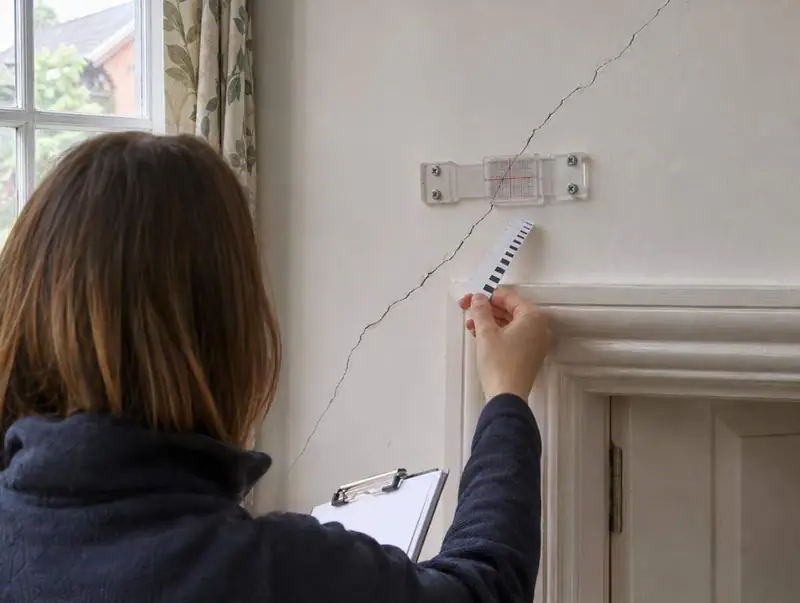
Gauges are fixed across key cracks and read at set intervals, or reference studs are measured with callipers to a fraction of a millimetre. The readings show whether each crack is widening, closing or stable, and whether any change follows the seasons.
Best for: Tracking individual cracks over the seasons
Level monitoring
Survey points are fixed around the building and their heights measured against a stable datum on each visit. This shows whether one part of the house is dropping or rising compared with the rest, which crack widths alone cannot reveal.
Best for: Suspected subsidence or heave across a whole house
What happens during structural surveys and crack monitoring, step by step?
Engineer’s inspection
We can arrange an independent chartered structural engineer to inspect. They record the damage, assess likely causes and recommend whether monitoring, drain surveys or trial pits are needed before any repair decision.
Install monitoring points
Tell-tales, measuring studs or level points are fixed at the locations the engineer chooses. A base reading is taken on the first visit, so every later reading can be compared against it.
Repair or close
If the readings show the house is stable, the engineer specifies the repair and we confirm a fixed price in writing. If movement continues, the cause is investigated further before a foundation repair is designed.
Do you need approval for structural surveys and crack monitoring in England?
Like-for-like repairs such as crack stitching and repointing do not usually need building control approval in England, but anything that changes or strengthens the structure, such as underpinning or rebuilding a wall, does. If the work touches a party wall, the Party Wall etc. Act 1996 may apply.
Towns in Lancashire we cover for structural surveys and crack monitoring
- Preston
- Burnley
- Blackburn
- Blackpool
- Morecambe
- Lancaster
- Lytham St Annes
- Skelmersdale
- Leyland
- Accrington
- Chorley
- Darwen
- Thornton-Cleveleys
- Nelson
- Fleetwood
- Ormskirk
- Rawtenstall
- Colne
- Poulton-le-Fylde
- Heysham
Questions about structural surveys and crack monitoring in Lancashire
Is the ground in Lancashire prone to subsidence?
Lancashire is mostly glacial till over sandstone and mudstone, with the Burnley and Accrington coalfield in the east and soft coastal and estuarine ground on the Fylde. Old mill and mine sites leave made ground in many towns. Parts of Lancashire lie on a former coalfield, so a coal mining search is worth checking if movement has no obvious cause. Only an investigation on site can say why a particular building has moved.
How much will structural surveys and crack monitoring cost in Lancashire?
On North West rates, structural surveys and crack monitoring starts from about £480 per property, including VAT. The written price depends on the extent of the damage, access and whether an engineer or building control is needed.
What is a tell-tale on a crack?
A tell-tale is a small gauge fixed across a crack, with two overlapping plates marked in millimetres. As the crack opens, closes or shears, the plates move against each other and the reading changes. It gives a simple, repeatable record that anyone can check between visits.
When should I get a structural engineer’s report?
It is worth getting one when cracks are wider than a few millimetres, tapered, getting worse, or accompanied by sticking doors and sloping floors. A mortgage valuer or insurer asking for one is another clear trigger. Fine, stable hairline cracks often do not need one.
What happens after the monitoring ends?
If the readings show the building is stable, the engineer specifies a repair, usually crack stitching and making good. If movement continues, further investigation and a foundation repair design follow. Either way, we confirm a fixed price in writing once the repair is specified.