Christchurch · Dorset
Structural surveys and crack monitoring in Christchurch
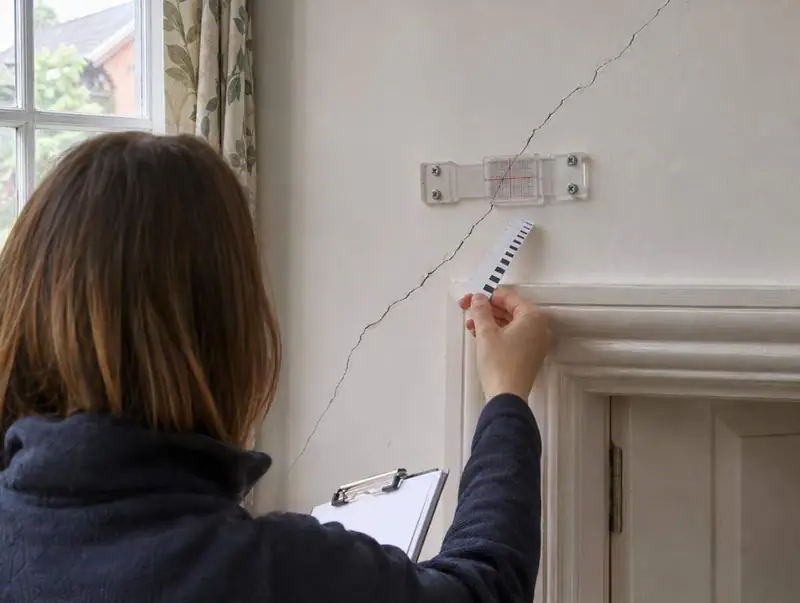
For homeowners in Christchurch unsure whether a crack is getting worse, the honest answer often needs measurement rather than a single look. Tell-tales and level points turn the question into clear figures the engineer can interpret.
Guide price from£515per property inc VAT
- Postcodes
- BH6, BH7, BH23
- Population
- about 31,000
- Area
- Dorset
- Pricing region
- South West
Is Dorset prone to ground movement?
Christchurch is in Dorset and takes in postcode districts BH6, BH7, BH23. About 31,000 people live there. If you are just outside Christchurch, we also cover Bournemouth (4 miles), New Milton (5 miles) and Ferndown (7 miles).
Parts of Dorset have clay that can shrink near trees in dry spells. Ground movement here is more often linked to soils, drains and trees than to mining. Across Dorset, most homes are stone and brick villages, Victorian villas in Bournemouth, and inter-war and post-war semis.
What to look for before calling about structural surveys and crack monitoring
- A crack you are unsure is old or new
- Cracks that seem wider after a hot, dry summer
- A mortgage valuation recommending a structural engineer’s report
Structural surveys and crack monitoring prices in Christchurch
The ranges below reflect typical South West costs for structural surveys and crack monitoring, including VAT. Scaffold, access and making good can push a job to the top of the range.
| Item | Guide price | Per |
|---|---|---|
| Structural engineer's inspection and report | £515 – £2,050 | per property |
| Crack monitoring: installation and three seasonal readings | £1,500 – £2,450 | per programme |
| Extra monitoring visit | £435 | per visit |
How we usually approach structural surveys and crack monitoring
Level monitoring
Survey points are fixed around the building and their heights measured against a stable datum on each visit. This shows whether one part of the house is dropping or rising compared with the rest, which crack widths alone cannot reveal.
Best for: Suspected subsidence or heave across a whole house
Tell-tales and crack-width monitoring
Gauges are fixed across key cracks and read at set intervals, or reference studs are measured with callipers to a fraction of a millimetre. The readings show whether each crack is widening, closing or stable, and whether any change follows the seasons.
Best for: Tracking individual cracks over the seasons
What happens during structural surveys and crack monitoring, step by step?
Install monitoring points
Tell-tales, measuring studs or level points are fixed at the locations the engineer chooses. A base reading is taken on the first visit, so every later reading can be compared against it.
Seasonal readings
Readings are taken at intervals across the seasons, typically including late summer when clay is driest and late winter when it is wettest. The engineer checks each set against the base reading and decides whether more visits are needed.
Repair or close
If the readings show the house is stable, the engineer specifies the repair and we confirm a fixed price in writing. If movement continues, the cause is investigated further before a foundation repair is designed.
Rules for structural surveys and crack monitoring in England
Like-for-like repairs such as crack stitching and repointing do not usually need building control approval in England, but anything that changes or strengthens the structure, such as underpinning or rebuilding a wall, does. If the work touches a party wall, the Party Wall etc. Act 1996 may apply.
Questions about structural surveys and crack monitoring in Christchurch
How much should I budget for structural surveys and crack monitoring in Christchurch?
Guide prices for structural surveys and crack monitoring in Christchurch start from about £515 per property, including VAT, on South West rates. Your fixed written price follows photos or a survey and depends on the extent of the work and access.
Can you survey a property in Christchurch?
Yes, Christchurch is covered, along with postcode districts BH6, BH7, BH23. We also cover nearby Bournemouth and New Milton.
Why do houses in Dorset crack?
Dorset mixes chalk downs, Oxford and Kimmeridge Clays in the vales, and the sands and gravels of the Poole basin. Clay vales can shrink and swell, and parts of the coast are known for landslip. Only an investigation can say why a particular building has moved.
What do BRE crack categories mean?
BRE Digest 251 groups damage by typical crack width. Category 0 is under 0.1 mm, 1 up to 1 mm, 2 up to 5 mm, 3 from 5 to 15 mm or several of about 3 mm, 4 from 15 to 25 mm, and 5 usually over 25 mm. It is a guide to severity, not a diagnosis of cause.
How long does crack monitoring take?
Monitoring normally runs for 6 to 12 months, because readings need to cover both the dry and wet seasons on clay soils. Shorter periods can be enough where the cause is clearly non-seasonal, such as a drain leak that has been repaired. The engineer decides when there is enough evidence.
Related work in Christchurch
- Boundary and garden wall repairs
- Roof structure repairs
- Bay window subsidence repairs
- Subsidence insurance claim repairs
- Lintel replacement
Structural surveys and crack monitoring near Christchurch
For a no-obligation written quote on crack monitoring in Christchurch, send photos and a note of when the cracks appeared and how they have changed.