Plymouth · Devon
Structural surveys and crack monitoring in Plymouth
A structural survey in Plymouth starts with an independent chartered structural engineer inspecting the cracks, the walls, the drains and any trees nearby. We can arrange that inspection, and the report sets out whether monitoring or a repair comes next.
Guide price from£515per property inc VAT
- Postcodes
- PL1, PL3, PL4
- Population
- about 260,000
- Area
- Devon
- Pricing region
- South West
Is Devon prone to ground movement?
Plymouth is in Devon and takes in postcode districts PL1, PL3, PL4. About 260,000 people live there. If you are just outside Plymouth, we also cover Saltash (4 miles).
Most of Devon is on firmer ground than the clay belts of the south-east. Old metal-mine shafts and workings are recorded in places, so mining searches are routine for some properties. What you mostly find across Devon: cob and stone cottages, Victorian terraces in Exeter, Plymouth and Torbay, and post-war estates.
Which repair method suits a home in Plymouth?
Tell-tales and crack-width monitoring
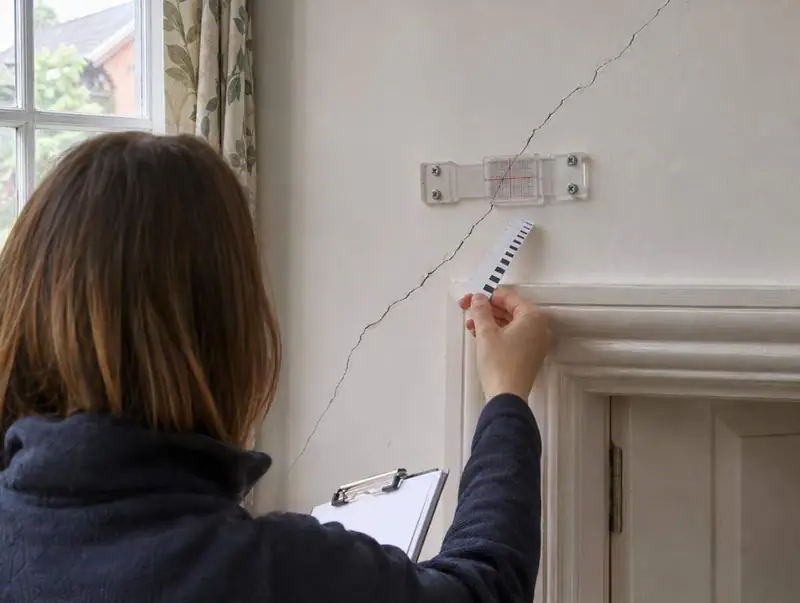
Gauges are fixed across key cracks and read at set intervals, or reference studs are measured with callipers to a fraction of a millimetre. The readings show whether each crack is widening, closing or stable, and whether any change follows the seasons.
Best for: Tracking individual cracks over the seasons
Engineer’s structural inspection and report
A chartered structural engineer visits, records the cracks, checks the walls, floors, drains and nearby trees, and writes a report on the likely cause and next steps. It may recommend monitoring, investigations such as trial pits, or a repair specification.
Best for: A first expert opinion on any significant cracking
What happens when we carry out structural surveys and crack monitoring in Plymouth?
Free initial assessment
Send photos of the cracks with something for scale and tell us when they appeared. We give a free view on whether an engineer’s inspection is worthwhile, and whether your insurer should be told first.
Seasonal readings
Readings are taken at intervals across the seasons, typically including late summer when clay is driest and late winter when it is wettest. The engineer checks each set against the base reading and decides whether more visits are needed.
Repair or close
If the readings show the house is stable, the engineer specifies the repair and we confirm a fixed price in writing. If movement continues, the cause is investigated further before a foundation repair is designed.
Signs you may need structural surveys and crack monitoring
- A mortgage valuation recommending a structural engineer’s report
- Cracks that seem wider after a hot, dry summer
- Doors and windows sticking at some times of year only
How much will structural surveys and crack monitoring cost in Plymouth?
Guide prices below are for homes in Plymouth, on South West rates and including VAT. A survey or good photos let us turn them into a fixed written price.
| Item | Guide price | Per |
|---|---|---|
| Structural engineer's inspection and report | £515 – £2,050 | per property |
| Crack monitoring: installation and three seasonal readings | £1,500 – £2,450 | per programme |
| Extra monitoring visit | £435 | per visit |
Rules for structural surveys and crack monitoring in England
Like-for-like repairs such as crack stitching and repointing do not usually need building control approval in England, but anything that changes or strengthens the structure, such as underpinning or rebuilding a wall, does. If the work touches a party wall, the Party Wall etc. Act 1996 may apply.
Structural surveys and crack monitoring in Plymouth: questions and answers
How much will structural surveys and crack monitoring cost in Plymouth?
Guide prices for structural surveys and crack monitoring in Plymouth start from about £515 per property, including VAT, on South West rates. Your fixed written price follows photos or a survey and depends on the extent of the work and access.
Do you cover Plymouth?
Yes. We take enquiries from across Plymouth, including PL1, PL3, PL4, and from nearby places such as Saltash. Send photos for a free initial view and we will tell you what happens next.
Is the ground in Devon prone to subsidence?
Devon's ground is mostly older mudstones, sandstones and granite, so shrinkable-clay subsidence is less widespread than further east. Older solid-walled and cob buildings, steep sites and retaining walls are the more common structural concerns. Only an investigation can say why a particular building has moved.
How long does crack monitoring take?
Monitoring normally runs for 6 to 12 months, because readings need to cover both the dry and wet seasons on clay soils. Shorter periods can be enough where the cause is clearly non-seasonal, such as a drain leak that has been repaired. The engineer decides when there is enough evidence.
What do BRE crack categories mean?
BRE Digest 251 groups damage by typical crack width. Category 0 is under 0.1 mm, 1 up to 1 mm, 2 up to 5 mm, 3 from 5 to 15 mm or several of about 3 mm, 4 from 15 to 25 mm, and 5 usually over 25 mm. It is a guide to severity, not a diagnosis of cause.
Other structural repairs in Plymouth
- Extension pulling away repairs
- Roof structure repairs
- Lintel replacement
- Concrete repairs
- Gable end wall repairs
Structural surveys and crack monitoring near Plymouth
Once monitoring at your Plymouth property shows what is needed, we confirm a fixed price in writing for the repair; send the report to start.