East Riding of Yorkshire · England
Bowing wall repairs in East Riding of Yorkshire
Looking for bowing wall repairs in East Riding of Yorkshire? Send us photos for a free initial view. Parts of East Riding of Yorkshire have clay that can shrink near trees in dry spells, so we look at the ground, drains and nearby trees before recommending anything.
Guide price from£950per wall inc VAT
- Area
- East Riding of Yorkshire
- Pricing region
- Yorkshire and the Humber
- Ground
- Clay in parts
- Towns listed
- 4
How do local ground conditions affect bowing wall repairs in East Riding of Yorkshire?
The Yorkshire Wolds are chalk, while Holderness and Hull sit on glacial till and estuarine clays and silts. Soft alluvial ground near the Humber can settle, and the Holderness coast is one of the fastest-eroding in Europe.
Ground movement here is more often linked to soils, drains and trees than to mining. Housing stock in East Riding of Yorkshire: Victorian terraces in Hull, market-town houses in Beverley and Driffield, and post-war estates.
Bowing wall repairs prices in East Riding of Yorkshire
Prices in East Riding of Yorkshire are worked out on Yorkshire and the Humber rates. They include VAT and are a starting point: access, the extent of the damage and whether an engineer or building control is involved all move the figure.
| Item | Guide price | Per |
|---|---|---|
| Lateral restraint for a typical gable | £950 – £2,850 | per wall |
| Remedial restraint ties installed | £25 – £55 | per tie |
| Partial rebuild of a badly distorted sectionest. | £2,850 – £7,600 | per section |
How we usually approach bowing wall repairs
Partial rebuild
A section that has bowed beyond safe limits, or where bricks have crushed, is propped, taken down and rebuilt plumb with restraint built in. It is the most disruptive option, so it is kept to the area that genuinely needs it.
Best for: Badly distorted sections that cannot be tied back
Stitching a delaminating wall
Where the layers of a solid wall have separated, long stainless ties are drilled in from the face and bonded into the inner layer to bind the wall together again. This is often combined with restraint ties, so the wall is both reconnected through its thickness and tied back to the structure.
Best for: Solid walls where the outer layer has pulled away
Restraint ties into the floor
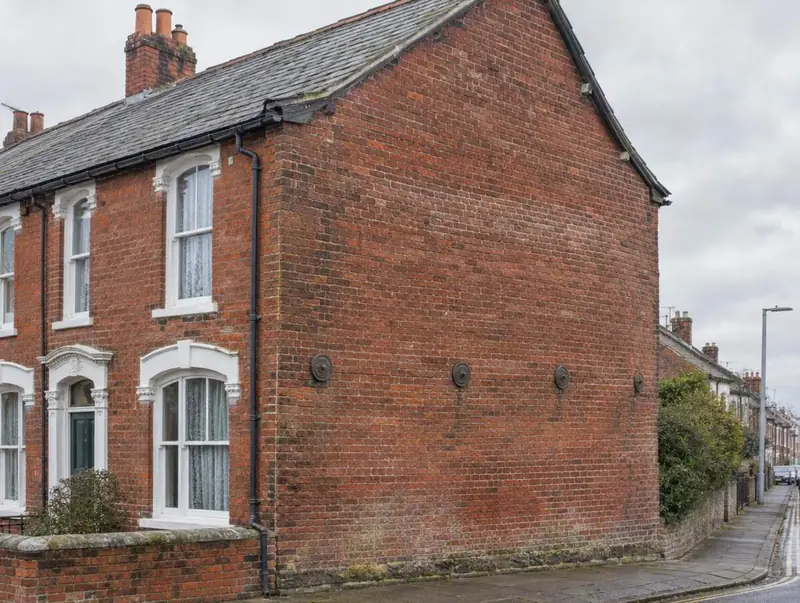
Stainless restraint ties are drilled through the wall and fixed into the floor joists or into blocking between them. Where joists run parallel, noggins are fitted across several joists so the tie has something solid to hold. A neat plate or a buried fixing is left on the outside face.
Best for: Walls bowing at floor level where joists run alongside
What happens during bowing wall repairs, step by step?
Assess the bow
We look at where the wall bows, how far it is out of plumb and how the floors and roof meet it. Photographs from your phone held flat against the wall often show the shape clearly before anyone visits.
Decide restrain or rebuild
If the wall is badly out of plumb, has bricks crushing or follows removed internal walls, we recommend an engineer, and can arrange one. Their view sets whether restraint is enough or a section needs rebuilding.
Close up and make good
Boards are relaid, plaster and outside fixings made good, and cracked joints repointed. You receive a record of the restraint positions, which helps if you sell or if an engineer needs to check the wall again later.
What to look for before calling about bowing wall repairs
- Gutters or the roof edge no longer lining up with the wall
- Horizontal cracking at first-floor or ceiling level
- Internal plaster cracks where a wall meets the ceiling
- Gaps opening between floorboards and the skirting on an outside wall
Do you need approval for bowing wall repairs in England?
In England, underpinning and other work that alters or strengthens a wall or foundation is building work under the Building Regulations (Part A, structure), so building control approves and inspects it. Like-for-like repairs often are not, and we tell you which applies before a price is agreed. Work to a party wall, or excavation close to a neighbour’s foundations, can also need a notice under the Party Wall etc. Act 1996.
Bowing wall repairs near you in East Riding of Yorkshire
Questions about bowing wall repairs in East Riding of Yorkshire
Does the ground around Hull cause cracking?
The Yorkshire Wolds are chalk, while Holderness and Hull sit on glacial till and estuarine clays and silts. Soft alluvial ground near the Humber can settle, and the Holderness coast is one of the fastest-eroding in Europe. Ground movement here is more often linked to soils, drains and trees than to mining. Only an investigation on site can say why a particular building has moved.
How much will bowing wall repairs cost in East Riding of Yorkshire?
On Yorkshire and the Humber rates, bowing wall repairs starts from about £950 per wall, including VAT. The written price depends on the extent of the damage, access and whether an engineer or building control is needed.
Does a bowing wall need an engineer?
Often it does, especially if the bow is large, growing or linked to removed internal walls or chimney breasts. Small, long-standing bows can sometimes be restrained to a standard detail. Where the repair needs an engineer’s design or sign-off, we can arrange an independent chartered structural engineer.
Do restraint ties show on the outside?
Some do and some do not. Certain ties leave a small round or square plate on the outside face, while others are fully recessed and pointed over. Straps fitted from inside leave no outside trace at all. We agree the finish with you before work starts.
How do I know if my wall is bowing?
Hold a long spirit level or a taut string against the wall and look for a gap in the middle. From inside, gaps between floorboards and skirting on an outside wall are a common clue. Photos showing the gap help us judge it before a visit.